
Cook Shire Council has adopted its 2026–27 Budget, setting the direction for the year ahead while balancing rising operating costs with continued investment in the infrastructure, services and community facilities our communities rely on every day.
The budget was shaped by Council’s largest-ever community budget engagement program, with more than 115 survey responses, written submissions and community conversations helping inform the final decisions.
The message from the community was clear.
Roads, footpaths and drainage remain the community’s highest priority.
At the same time, residents told us cost-of-living pressures continue to affect households across the Shire.
This year’s budget has been developed to respond to both.
Budget at a glance
The 2026–27 Budget delivers:
- 23 Operational Plan initiatives
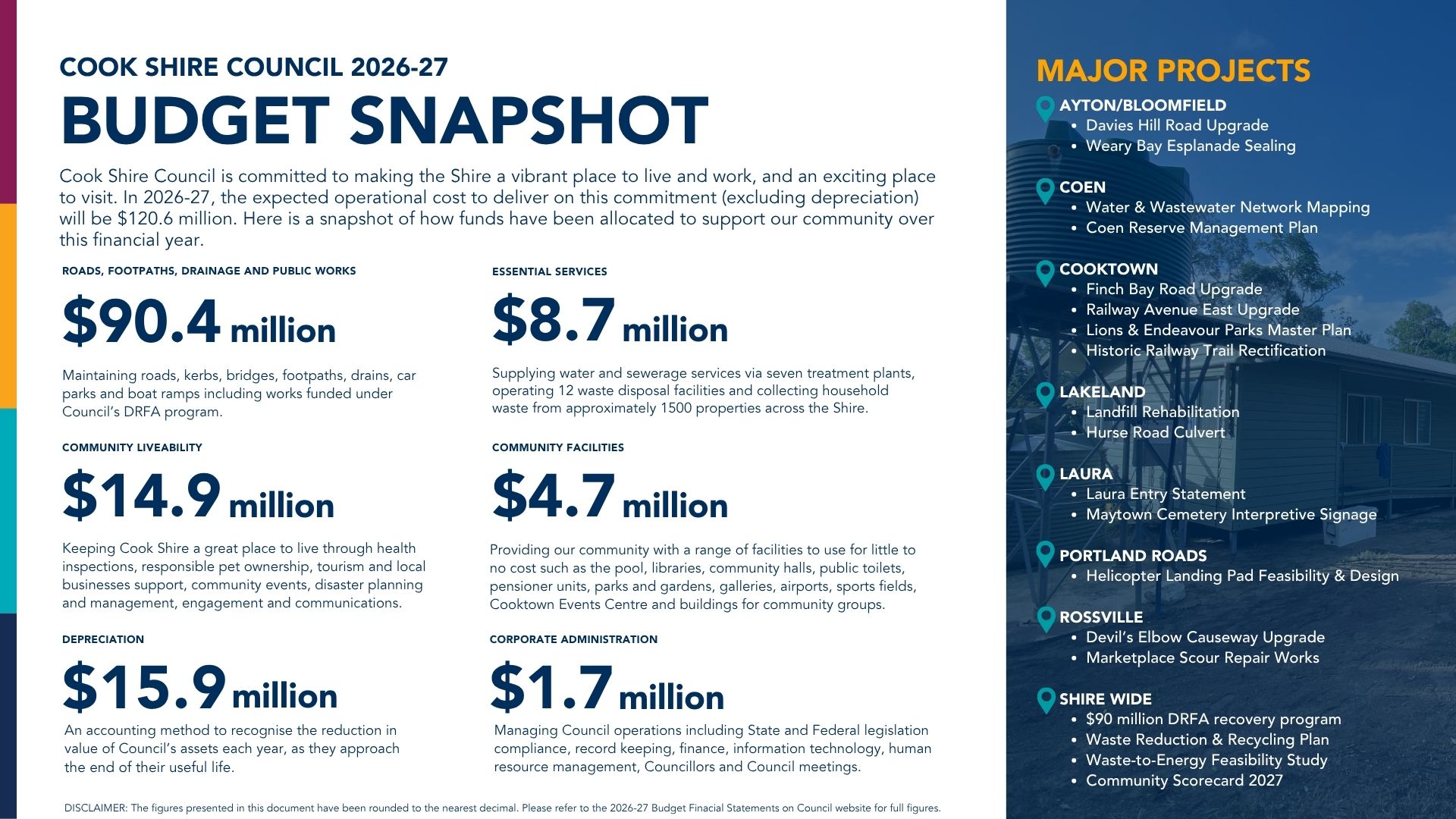
- $9.35 million Capital Works Program
- Approximately $90 million in Disaster Recovery Funding Arrangements (DRFA) works
- Continued investment in roads, drainage and essential infrastructure
- Increased support for eligible pensioners
- Continuation of Council’s Early Payment Incentive
Why isn’t everyone’s rates increase the same?
One of the most common questions following the adoption of the budget is:
“How does this affect my rates?”
The answer depends on your property.
Approximately 51% of residential ratepayers are assessed at Council’s minimum residential general rate and will see their general rates increase by $79 per year—around $1.50 per week.
Other residential properties are generally located outside the major townships where land has been valued by the Queensland Valuer-General at more than $130,000. These properties are assessed under Council’s differential rating system, meaning there is no one-size-fits-all increase. General rates vary according to each property’s land valuation and differential rating category.
It is also important to remember that general rates are only one part of your annual rates notice.
Your rates notice may also include service charges for water, sewerage and waste, together with statutory levies collected by Council on behalf of other organisations.
What does this mean in practice?
Every property is different, so there is no single increase that applies to every rates notice.
However, for a typical residential property in the following communities, the combined increase across Council rates, service charges and applicable levies is:
Coen
For a typical Coen residential property, the total increase is $309 per year
Cooktown
For a typical Cooktown residential property with a 240-litre wheelie bin, the total increase is $302 per year, or around $5.80 per week.
This is made up of:
- General rates: +$79
- Water Access Charge: +$81
- Sewerage Charge: +$90
- Waste Collection (240L bin): +$35
- Environmental & Waste Operations Levies: +$17
Laura
For a typical Laura residential property, the total increase is $334 per year.
PLEASE NOTE:
The above examples of Coen, Cooktown and Laura, have been selected because they represent typical residential properties receiving the core residential Council services, allowing a like-for-like comparison of residential rates notices. They are intended as a guide only. We encourage all ratepayers to review the adopted Budget documents and contact Council’s Rates Officer for advice specific to their individual property.
Why has my waste collection charge increased?
Waste collection is a service charge, not a general rate.
The biggest cost to Council isn’t disposing of your waste—it’s collecting your bin.
Whether it’s a 120-litre or 240-litre bin, the collection truck still has to drive to your property, stop, lift and empty the bin. Because those collection costs are largely the same, the 120-litre service has historically been heavily subsidised.
Council is gradually moving towards full cost recovery, meaning users pay a fairer share of the actual cost of the service. While the 120-litre bin has a higher percentage increase this year, it remains Council’s lowest-cost kerbside waste collection option.
Supporting ratepayers
Council recognises the financial pressures many households continue to experience. To help support eligible residents:
Increased pensioner concession
From 1 July 2026, Council’s own pensioner concession has increased from $200 to $240 per annum.


Early Payment Incentive
Council will continue offering its Early Payment Incentive, providing a $100 annual discount ($50 per rates notice) to ratepayers who pay their rates by the due date.
Want to understand your rates notice?
Your annual rates notice is made up of a number of different charges, including:
- General rates – which help fund the broad range of services Council provides across the Shire.
- Service charges – including water, sewerage and waste collection.
- Statutory levies – which Council collects on behalf of other organisations.
For 2026–27:
- The Queensland Government’s Emergency Management Levy (EML) has increased. This levy is set by the Queensland Government and collected by Council on its behalf.
- The Rural Fire Levy (RFL) remains unchanged for properties within the Marton, Poison Creek, Rossville and Bloomfield Rural Fire Brigade areas.
If you’d like to learn more about how your rates notice is calculated and what each charge means, we’ve prepared a detailed guide.
Read the budget
The full 2026–27 Budget documents are available through the 30 June 2026 Ordinary Council Meeting Agenda, including:
- Budget Report
- Revenue Statement
- Fees and Charges
- Operational Plan
- Capital Works Program
Council has also published a downloadable Budget summary to provide you with an easy-to-read overview of the adopted budget, major projects and key initiatives for the year ahead.
Have a question?
We understand that budgets and rates can be be complex, and every property is different. We are here to help.
If you have questions about how the adopted budget affects your individual property, please contact us to arrange a time to speak with Council’s Rates Officer.
Call us on 4082 0500
Email mail@cook.qld.gov.au